

Cholesterol & BMI
It’s easy to work out if you have a healthy weight and shape and whether your size is likely to affect your heart health. Just calculate your Body Mass Index (BMI) and measure your waist to find out if you’re an apple or a pear!
Cholesterol and BMI: Does Your Weight Affect Your Cholesterol?
If you've recently discovered that you have high cholesterol, you might be wondering whether your weight has something to do with it.
The simple answer is: it can, but weight is only one part of the picture.
Carrying excess weight can increase your likelihood of having high cholesterol and other conditions that affect heart health. But importantly, you don't have to be overweight to have high cholesterol. Genetics, diet, activity levels, age and other aspects of your health can all play a role.
So rather than focusing on weight alone, it helps to understand the bigger picture.
What Is BMI?
BMI stands for Body Mass Index. It's a simple calculation using your height and weight that can help indicate whether your weight is in a healthy range.For most adults:
- Below 18.5: underweight
- 18.5 to 24.9: healthy weight
- 25 to 29.9: overweight
- 30 or above: living with obesity
However, BMI is only a guide. It can't distinguish between fat and muscle, and it doesn't tell you where fat is stored around your body. [nhs.uk]
Different BMI thresholds are also used for some ethnic backgrounds because the risk of health problems can occur at a lower BMI. Current UK guidance uses lower thresholds for people from South Asian, Chinese, other Asian, Middle Eastern, Black African and African-Caribbean backgrounds. [nhs.uk]
What's the Connection Between Weight and Cholesterol?
Being overweight can be associated with higher cholesterol and triglyceride levels, particularly when excess fat is carried around the middle. Maintaining a healthy weight can therefore be an important part of looking after both your cholesterol and your overall heart health. [heartuk.org.uk], [bhf.org.uk]
But here's the important bit:
Your BMI doesn't tell you what your cholesterol level is.
Someone with a BMI in the healthy range can still have high cholesterol, while someone with a higher BMI won't necessarily have the cholesterol result you might expect.
The only way to know your cholesterol level is to have it tested.
Can You Have High Cholesterol If You're Slim?
Yes.
High cholesterol isn't simply a weight issue.Your cholesterol can be affected by your diet, genetics, age, activity levels, smoking, alcohol consumption and certain medical conditions, as well as your weight.
That's why being slim doesn't necessarily mean you have healthy cholesterol.
If you're concerned about your cholesterol, focus on knowing your numbers rather than assuming your weight tells you the answer.
Is Waist Size Important Too?
Yes. In fact, BMI shouldn't necessarily be considered on its own.Carrying excess fat around your middle is associated with an increased risk of high cholesterol, high blood pressure, type 2 diabetes and heart and circulatory diseases. [bhf.org.uk]
One useful measure is your waist-to-height ratio.
The advice is simple:
Try to keep your waist measurement to less than half your height.
For example, if you're 170cm tall, you would aim for a waist measurement below 85cm.Waist-to-height ratio can be used alongside BMI for adults with a BMI below 35. [nhs.uk], [bhf.org.uk]
How to measure your waist
To measure your waist:- Find the bottom of your ribs and the top of your hips.
- Place a tape measure halfway between the two.
- Wrap it around your waist without pulling it too tightly.
- Breathe out naturally and take the measurement.
- Divide your waist measurement by your height, using the same units for both.
A result below 0.5 means your waist is less than half your height. [bhf.org.uk]
Will Losing Weight Lower My Cholesterol?
If you're carrying excess weight, losing some of it may help improve your cholesterol and triglyceride levels as well as supporting your wider health. Even relatively modest weight loss can have health benefits. [nhs.uk], [heartuk.org.uk]But lowering cholesterol isn't simply about losing weight.
It's better to think about the healthy habits that can support both your weight and your cholesterol.
1. Make Simple Food Swaps
Instead of thinking about a restrictive "diet", look for small changes you can make regularly.Try swapping:
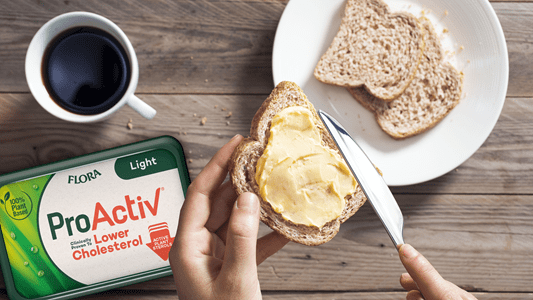
- Butter or ghee → vegetable oil-based spreads
- Fatty or processed meats → fish, beans or pulses
- Biscuits and cakes → fruit or unsalted nuts
- White bread → wholegrain bread
- Foods high in saturated fat → alternatives containing unsaturated fats
Reducing saturated fat and replacing it with healthier unsaturated fats is recommended to help lower cholesterol. [nhs.uk]
Simple cholesterol-lowering food swaps
2. Build Meals Around Heart-Healthy Foods
Try to regularly include:- Fruit and vegetables
- Wholegrains
- Oats and barley
- Beans and pulses
- Nuts and seeds
- Oily fish
Rather than trying to eat perfectly, focus on making these foods a bigger part of your everyday diet.
Explore our heart-healthy recipes
3. Move More
Regular activity can support cholesterol management, weight management and your overall cardiovascular health.Adults should aim for at least 150 minutes of moderate-intensity activity or 75 minutes of vigorous activity each week. Brisk walking, swimming and cycling are all good options. [nhs.uk]
You don't have to do it all at once. Find something you enjoy and build it into your routine.
4. If You Need to Lower Your Cholesterol, Consider Plant Sterols
Foods containing added plant sterols can help lower cholesterol as part of a healthy diet and lifestyle.
ProActiv® spreads contain added plant sterols, giving people who need to lower their cholesterol a simple way to incorporate plant sterols into their everyday routine.
What are plant sterols and how do they work?
What If My BMI Is Healthy but My Cholesterol Is High?
Don't panic, and don't assume you've done something wrong.
Weight is only one of the factors that can influence cholesterol.If your cholesterol is high despite having a healthy BMI and lifestyle, other factors may be involved. Your healthcare professional can look at your cholesterol results alongside your age, family history, blood pressure and wider health.
The important thing is to understand your results and focus on the changes that are appropriate for you.
What causes high cholesterol?
The Bottom Line
BMI can be a useful indicator of whether your weight may be affecting your health, but it's not a cholesterol test and it doesn't tell the whole story. BMI also has limitations, which is why waist-to-height ratio can provide useful additional information about fat carried around the middle. [nhs.uk], [bhf.org.uk]If you're carrying excess weight, working towards a healthier weight can support your cholesterol and overall heart health. But people of all shapes and sizes can have high cholesterol.
The most important thing is to know your numbers and focus on healthy habits you can maintain.